St Ives Museum has opened for its 2026 season, and as well as its magnificent permanent collection, its journey into local art history is continuing.
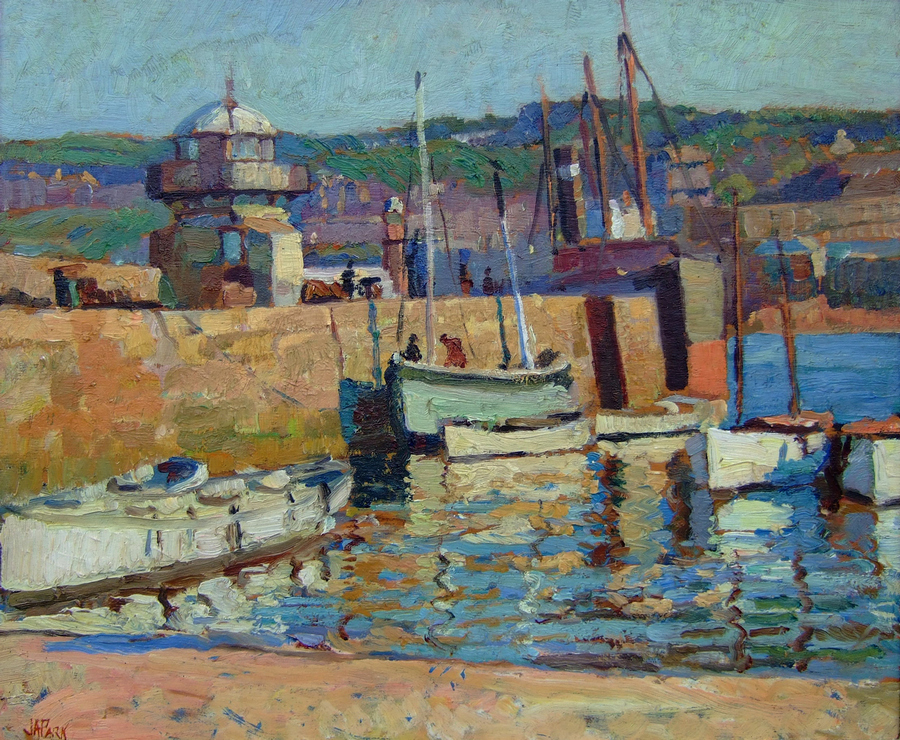
Smeaton’s Pier, by John Anthony Park
For this year, the focus is on the years 1930 to 1960, a fascinating history in not only St Ives’ but Britain’s modern art history.
“Our 2023 show featured early visitors and pioneers of the colony, which became established when the first artists over-wintered in St Ives,” museum curator Andy Smith told St Ives Local. “The subsequent exhibitions have taken the story through to 1930, and the museum now features art of the period up to 1960.
“The show focuses on representational art. However, the museum acknowledges the major impact which the growth of
the modern art movement in its formative years had on St Ives.”
Art historian David Tovey has supported each of the previous exhibitions, and has again provided comprehensive notes for
visitors. He explains that the period from 1930 to 1960 witnessed the heyday of the St Ives Society of Artists (STISA). Membership was open to any artist who had worked in Cornwall, and many Royal Academicians were involved, including Stanhope Forbes, John Lamorna Birch, Laura Knight, Dod Procter, and Stanley Spencer.
David paid tribute to the “indefatigable enthusiasm” of Robert Borlase Smart, STISA’s secretary, who organised touring shows around the country. “Between 1931 and 1949, over 20 public galleries hosted exhibitions by STISA,” he said. “This brought St Ives art to a wider public than ever before. St Ives art really did make waves during this period. It was an extraordinary achievement.”
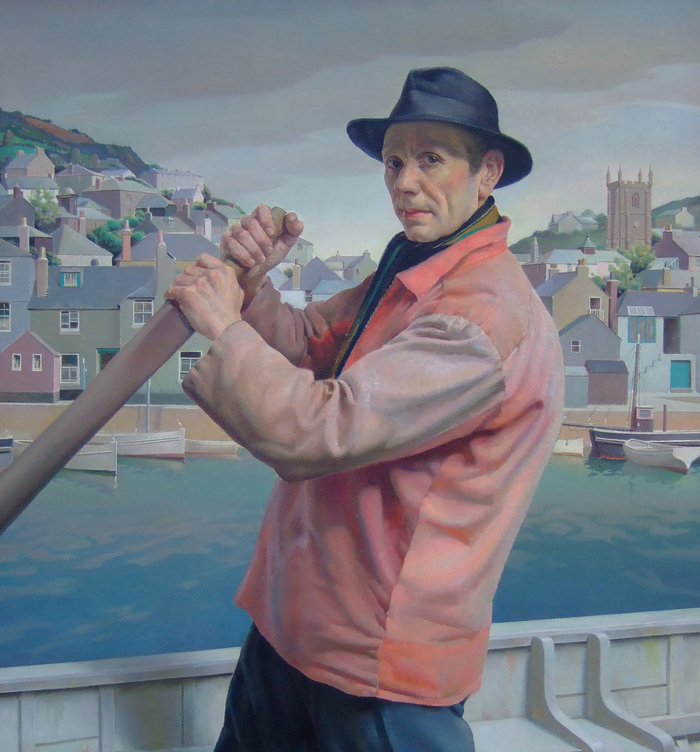
The exhibition concentrates on the St Ives resident artists whose contemporary style appealed to many of the public galleries that hosted the touring shows and acquired some of their works. These artists included Arthur Hayward and George Bradshaw. Postcards of Hayward’s self-portrait The Boatman (above), and Bradshaw’s painting In St Ives Bay, will be available from the museum, along with John Anthony Park’s Smeaton’s Pier.
Some of the artists featured in the show can be classified as British Impressionists, working in a looser, more colourful style than pre-First World War St Ives artists. In the Second World War, St Ives was seen as a safe haven, and artists who came to live in the town, including Ben Nicholson, Barbara Hepworth, and Naum Gabo, inspired others to experiment with non-representational work.
But, as David Tovey explained: “The relationship between the older traditional artists and the moderns was never that easy, and after Borlase Smart’s death in 1947, tensions rose, so that, in 1949, there was a very acrimonious split, when many members of STISA resigned and formed the Penwith Society.
“In fact, the publicity resulting from the 1949 bust-up meant that STISA’s sales in the early 1950s were the best ever. However, grant-giving bodies and the media in the 1950s were distinctly hostile to representational art, and a number of artists who had made considerable waves in the 1930s and 1940s found the art market very difficult by the end of the decade, whilst the moderns went on to achieve national and international reputations.”
Making Waves runs until October. Andy Smith is the latest interviewee in our series of podcasts. Search for St Ives Local Podcast on Spotify or Apple.
St Ives Museum | Wheal Dream, St Ives TR26 1PR | stivesmuseum.co.uk/